
The text shows a classic high-control pattern: it frames critics as dangerous abusers, turns media scrutiny into persecution, and uses that threat narrative to harden loyalty inside the group.[1][2]
Deflection through accusation
- The repeated focus on “false accusations” of child abuse works as a pre-emptive counterattack: instead of addressing criticism, the group recasts itself as the victim of a malicious smear campaign.[1]
- This is a powerful coercive move because it teaches members that allegations against the group should be dismissed as hostile propaganda before they are examined.[3][1]
Fear and paranoia
- The text insists the “mainscam media” can “destroy any person’s life in moments,” which inflates risk and creates a climate of constant vulnerability.[1]
- It then generalizes that danger to ordinary supporters, saying “they’re targeting us collectively” and “you’re already a target,” which is a direct fear-based control message.[1]
- In cultic settings, this kind of threat inflation is closely associated with phobia indoctrination and emotional control.[2][3]
Isolation and dependency
- The article tells readers to “come together” with “like-hearted, like-spirited individuals,” while positioning external institutions as unsafe and dishonest, which narrows members’ trusted world to the group itself.[1]
- That social narrowing increases dependence: if the outside world is framed as predatory, leaving feels like exposure rather than liberation.[4][1]
Information control
- The text repeatedly labels mainstream outlets as deceptive “executioners” and “mainscam media,” which encourages members to distrust outside reporting wholesale.[1]
- It presents the group’s own narrative as the corrective truth, a pattern that matches high-control information environments where outside sources are treated as contaminated.[5][3][1]
Coercive moral framing
- By linking false allegations, public humiliation, and spiritual language, the text turns disagreement into moral warfare rather than evidence-based debate.[1]
- That matters because once criticism is framed as evil or abusive, loyalty becomes a moral duty and questioning leadership becomes psychologically costly.[6][2][1]
Overall pattern
- Taken together, the piece uses a familiar control cycle: external enemy, heightened fear, collective victimhood, distrust of outsiders, and intensified in-group belonging.[7][2][1]
- In Lifton’s terms, it leans on loaded language, milieu control, and sacred framing; in Hassan’s terms, it combines information, thought, and emotional control.[2][3][7]
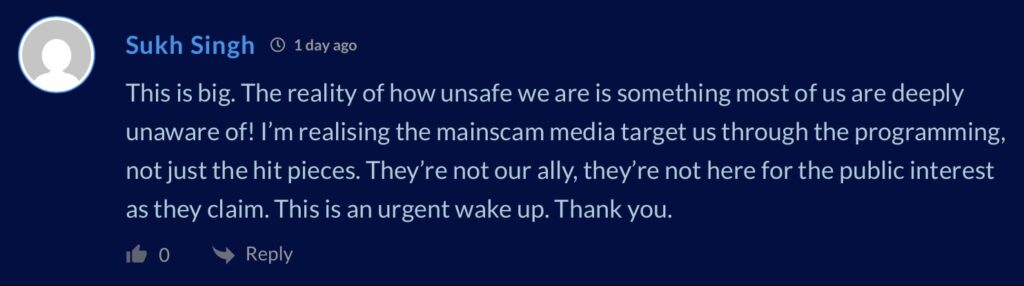
Todays Prize Comment
Sources
[1] file.txt https://lighthouseglobal.media/19th-march-2026-lighthouse-thursday-update-how-the-mainscam-media-destroys-lives-through-dark-deception/
[2] BITE Model of Authoritarian Control – Freedom of Mind … https://freedomofmind.com/cult-mind-control/bite-model-pdf-download/
[3] BITE-model.pdf https://freedomofmind.com/wp-content/uploads/2023/08/BITE-model.pdf
[4] Coming out of the Cults – ICSA Articles 1 https://articles1.icsahome.com/articles/coming-out-of-cults-singer
[5] Robert Jay Lifton Criteria for Thought Reform – cult recovery 101 https://cultrecovery101.com/cult-recovery-readings/robert-jay-lifton-criteria-for-thought-reform/
[6] Robert Jay Lifton’s eight criteria of thought reform as applied to the … https://www.cs.cmu.edu/~dst/NXIVM/esp11.html
[7] Eight criteria for thought reform in cults – ICSA https://internationalculticstudies.org/icsa-insights/eight-criteria-for-thought-reform-in-cults/