
The text uses a strongly coercive religious framework: it presents the group’s worldview as the only path to healing, depicts outsiders as corrupt or deceptive, and frames leaving or disagreeing as spiritually dangerous.[1][2]
False religion and sacred framing
- The article blends scripture, salvation language, and the leader’s interpretation into a closed system where “realignment,” “unbreeching,” and “the grace of God” are presented as the only route to wholeness.[1]
- This resembles sacred science in Lifton’s terms: doctrine is treated as unquestionable truth, while alternative perspectives are dismissed as shallow “self-help” or “gurus.”[3][4]
- The group also recasts its own activity as uniquely divine and historically necessary, which is a common feature of high-control religious movements that claim exclusive access to truth.[2][1]
Paranoia and threat inflation
- The text repeatedly claims the BBC and “the Establishment” stole personal data, misrepresented the group, and tried to “decimate” the group’s reputation, turning criticism into a vast persecution narrative.[1]
- It also depicts the world as a trap, school as a deforming system, and mainstream society as “Scamtopia,” which amplifies suspicion and makes ordinary institutions seem hostile.[1]
- That kind of fear-based worldview fits recognized patterns of thought reform and emotional control, especially when outside systems are portrayed as inherently unsafe.[5][6]
Coercive control through identity
- The text says people are “born into misalignment,” “breeched,” and “suffocating,” which pathologizes the reader’s current identity and creates dependence on the group’s solution.[1]
- By defining normal life as spiritually broken, it pressures readers to accept the group’s intervention as necessary rather than optional.[1]
- This is consistent with high-control environments that first undermine self-trust, then offer the group as the only source of restoration.[6][7]
Isolation and dependency
- The text warns that trying to leave will provoke “gaslight, bully, intimidate, and admonish” responses from family and friends, which normalizes social rupture as part of the path to truth.[1]
- It then presents Lighthouse as a “safe, protective environment” for rescue from the outside world, encouraging members to rely on the group for emotional and social survival.[1]
- That pattern matches cultic dependency: outsiders are cast as hostile, while in-group relationships become the main source of belonging and safety.[7][8]
Loaded language and thought control
- The repeated use of terms like “Scamtology,” “Scamtopia,” “mainscam media,” and “unbreech” is classic loaded language: it compresses complex reality into group-approved slogans.[1]
- The article also uses binary logic—aligned versus misaligned, truth versus deception, God versus the system—which discourages nuance and independent judgment.[3][1]
- In Hassan’s BITE framework, this supports thought and information control by shaping how members interpret everything they see and hear.[5][6]
Coercive moral pressure
- Leaving is framed not just as risky, but as a moral failure that leads to suffocation, spiritual decline, and rejection by loved ones.[1]
- The text therefore weaponizes shame and fear to keep people compliant, while making obedience feel like courage and dissent feel like self-destruction.[2][1]
Overall, the text shows a high-control system built on fear, exclusivity, and spiritualized dependency, with strong markers of loaded language, persecution thinking, and coercive identity shaping.[6][3][5][1]
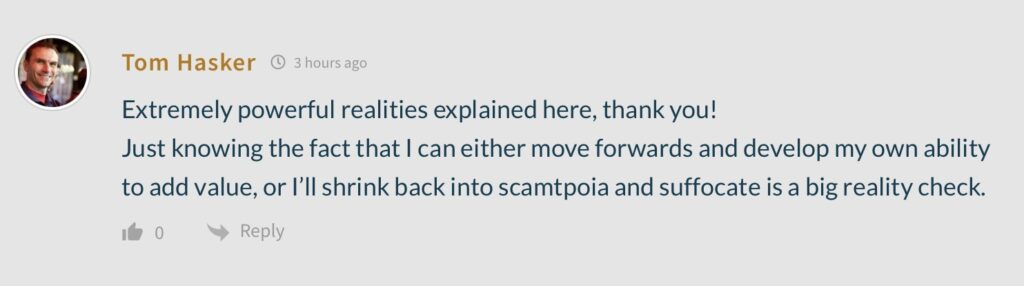
Todays Prize Comment
Sources
[1] file.txt https://paulswaugh.com/the-human-breech-syndrome/
[2] Eight criteria for thought reform in cults – ICSA https://internationalculticstudies.org/icsa-insights/eight-criteria-for-thought-reform-in-cults/
[3] Robert Jay Lifton’s eight criteria of thought reform as applied to the … https://www.cs.cmu.edu/~dst/NXIVM/esp11.html
[4] Robert Jay Lifton Criteria for Thought Reform – cult recovery 101 https://cultrecovery101.com/cult-recovery-readings/robert-jay-lifton-criteria-for-thought-reform/
[5] BITE Model of Authoritarian Control – Freedom of Mind … https://freedomofmind.com/cult-mind-control/bite-model-pdf-download/
[6] BITE-model.pdf https://freedomofmind.com/wp-content/uploads/2023/08/BITE-model.pdf
[7] ICSA Articles 1 – A Workshop for People Born or Raised in Cultic Groups https://articles1.icsahome.com/articles/sgaworkshop
[8] Coming out of the Cults – ICSA Articles 1 https://articles1.icsahome.com/articles/coming-out-of-cults-singer