
The text shows multiple patterns consistent with high‑control / cultic methods: all‑or‑nothing framing, manufactured enemies, gaslighting of critics, and heavy moral blackmail.[1]
1. Us‑versus‑them and paranoia
- The article repeatedly frames “fake whistleblowers” as deeply malicious, “pernicious, vindictive and dark,” and part of a wider attack on Lighthouse, constructing a persecuted‑group narrative.[1]
- Research on destructive groups notes that portraying the group as uniquely under siege by external enemies (media, “defamers,” “tyrannical forces”) is a classic way to amplify fear, dependency, and compliance.[2]
- By tying critics to biblical traitors (“Judas blew the fake whistle on Christ”) the text implies that questioning the leadership is equivalent to betraying Christ himself, which can make doubt feel spiritually dangerous rather than thoughtfully responsible.[3][1]
2. Delegitimising dissent and whistleblowing
- The piece tightly redefines “real” vs “fake” whistleblowers, asserting that those who speak against Lighthouse only “cry victim and virtue signal to cover up their own wrongdoing and irresponsibility.”[1]
- Cultic‑control literature highlights how groups commonly label ex‑members and whistleblowers as liars, slanderers, or mentally/spiritually defective to pre‑emptively discredit any negative testimony and block critical information.[4][2]
- Promising a series of “case studies” of named critics as “fake whistleblowers” further personalises this delegitimisation, signalling to current members what happens if they publicly criticise or leave.[4][1]
3. Moral blackmail and coercive framing
- The text repeatedly links loyalty to Lighthouse with loyalty to God, stating the work is “undeniably made possible by God’s love and Grace,” and positioning the organisation as a uniquely God‑ordained instrument.[1]
- In such settings, disagreement with leadership can be framed as disobedience to God, which functions as moral and spiritual blackmail: members may fear that questioning practices risks divine disapproval or loss of salvation.[5][3]
- Presenting critics as evil actors who “tried to destroy us in vain; they failed miserably by the grace and protection of God Almighty” tells insiders that God is on the leadership’s side against critics, increasing pressure to align with the in‑group to stay on the “right” side spiritually.[3][1]
4. Gaslighting and character assassination
- The article suggests that people who raise concerns “seem to suffer personal cost like [real whistleblowers] too… but they aren’t and do not,” implying that their reported harms are fake or exaggerated.[1]
- This fits gaslighting patterns described in cult‑recovery literature, where the group systematically denies or reinterprets others’ distress as manipulation, thereby invalidating their experiences and discouraging empathy from remaining members.[6][4]
- Naming specific individuals as “fake whistleblowers” and directing readers to external “awful case” material about them is a strong form of character assassination, which signals that reputational destruction awaits anyone who publicly challenges the group.[4][1]
5. Control through information and narrative
- The text promises ongoing “education” using Lighthouse’s “personal experiences” as the authoritative lens for understanding whistleblowing. Members are directed to Lighthouse‑run sites for “the truth” about critics.[1]
- High‑control groups typically centralise interpretation of events and discourage independent sources, using internal case studies and “exposés” to keep members reliant on the group for defining reality.[2][6]
- By framing external journalism and complaints as coordinated fake‑whistleblower operations, the piece primes readers to distrust any outside narrative that contradicts leadership.[2][1]
6. Implicit threats and social control
- While there is no explicit threat of physical harm, reputational and spiritual threats are clear: critics are likened to Judas and portrayed as morally corrupt enemies of God’s work.[1]
- Studies of coercive groups note that the threat of shunning, reputational ruin, or being branded spiritually dangerous can be as coercive as overt physical threats, especially in tightly bonded religious communities.[5][3]
- Publicly promising to publish more case studies on named individuals (Dawn Ingram, Martin Francis, etc.) signals the leadership’s willingness to “go after” detractors in detail, which can function as a deterrent to internal dissent.[4][1]
7. Overall cultic‑control pattern
Taken together, the tactics in this text align with recognised patterns in high‑control environments:
- Milieu control: Steering members toward group‑produced material and framing external critics as dangerous or deceitful.[2][1]
- Doctrine over person: Reinterpreting whistleblowers’ experiences as proof of their pathology rather than engaging with their substantive concerns.[6][1]
- Demand for purity / absolute loyalty: Equating criticism with betrayal of Christ and opposition to God’s work.[3][1]
- Dispensing of existence: Depicting critics as morally illegitimate “fake whistleblowers,” implying their voices have no rightful place in the moral community.[2][1]
These features are consistent with patterns described by cult researchers such as Lifton and Singer for environments that exert coercive influence and suppress dissent.[3][2]
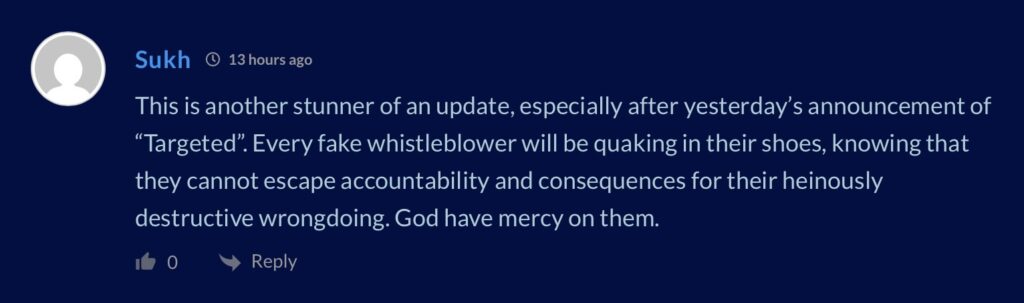
Todays Prize Comment
Sources
[1] [2] https://lighthouseglobal.media/23rd-march-2026-lighthouse-monday-update-what-is-a-fake-whistleblower/
[3] Thought Reform and the Psychology of Totalism https://en.wikipedia.org/wiki/Thought_Reform_and_the_Psychology_of_Totalism
[4] Dr. Robert J. Lifton – Eight Criteria for Thought Reform https://www.cultrecover.com/lifton8
[5] Robert Jay Lifton’s eight criteria of thought reform as applied to the … https://www.cs.cmu.edu/~dst/NXIVM/esp11.html
[6] Eight criteria for thought reform in cults – ICSA https://internationalculticstudies.org/icsa-insights/eight-criteria-for-thought-reform-in-cults/